
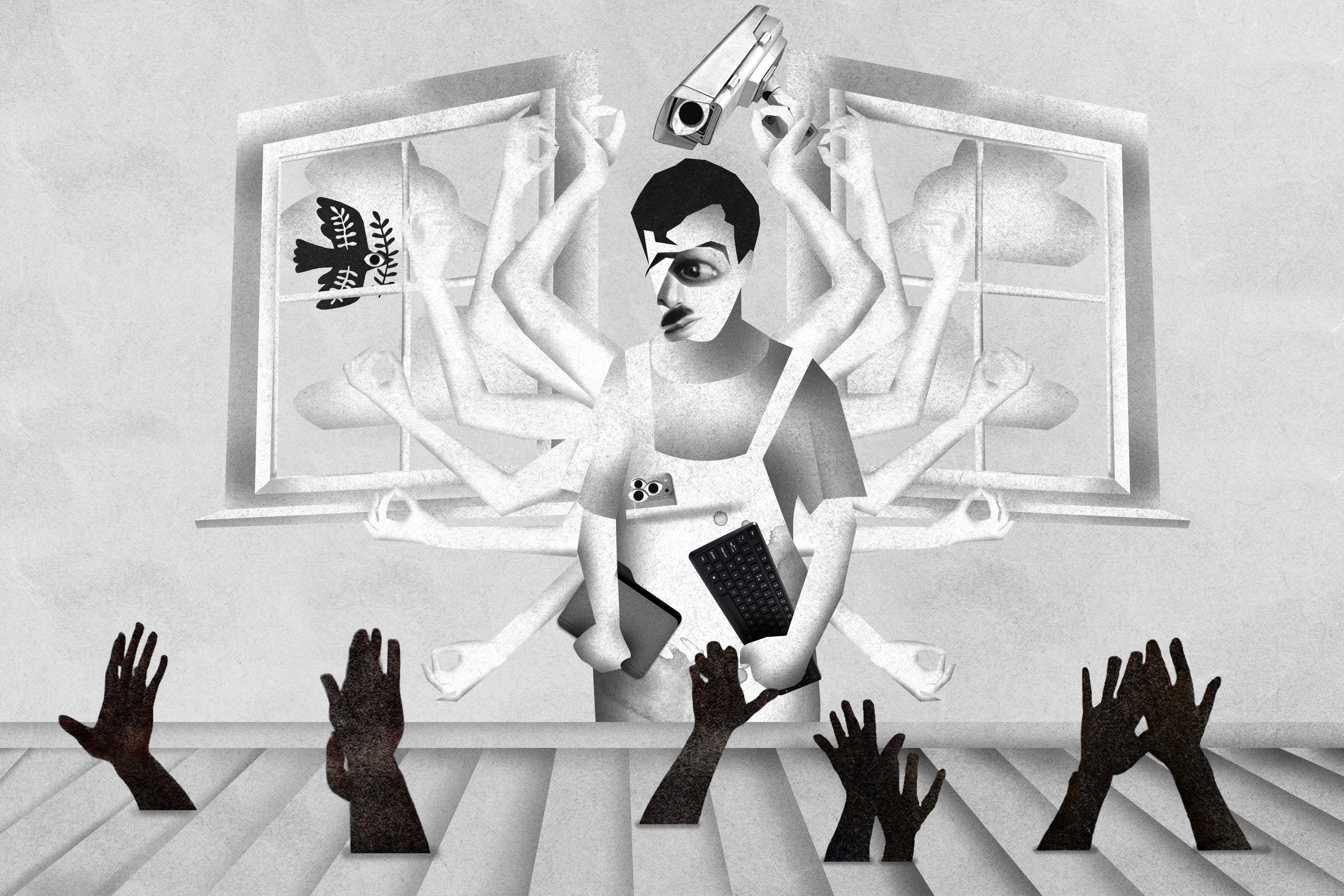
This was an essay developed for a module called “Context” regarding “Ethics and Authorship” on my Masters studies in Advanced Graphic Design at Elisava. Presented in October 2026
I had my first encounter with the benefits and El Dorado promises of Artificial Intelligence at the same time as the rest of the world. Before that, it seemed an Asimov thing, with a programming barrier that looked like the Matrix green font on black universe. The Silicon Valley Tech Oligarchy had to translate that into a friendlier interface that could make sense to the masses. When the monolith of 2001 appeared, the working class had to sniff around and understand what that even was. In less than half a decade, the relationship went from a mystical one with an all-knowing oracle, to the Terminator, to something fundamental for some everyday tasks.
The main question now in front of the design sector is how to use adapt to this tool capable of shifting paradigms well established in the field, and if it is even ethical to see this new technology as a tool worth investing time in.
Design is a bridge between the physical scenarios we find ourselves in and the humanity inside us. Toning down the Utopia aspect, what makes design an industry different from other creative forms is the objective and the intention of the piece: to affect its surroundings as well as to evoke emotions in the receptor towards a pre-determined goal. The design mind is a product of the Industrial Revolution, when solutions needed to be translated into functional pieces based on an original practical problem. Because of that, design tends to be the rational creative industry, where in a consumerist society through the time theories and trends shaped a more homogenous language and process of problem solving. From the pure capitalist north star of selling something to more idealistic ones like making a cause known, the designer is the architect of the bridge that will take people there.
Being so objective-oriented, design is more susceptible to the threats posed by super-powered computer programs that can assimilate whatever data you put into them. We now have at our disposal software engineered to interpret vast amounts of data, create logical responses and plan actions when presented with a clear goal, and that has enormous potential for capital. The main threat is the evolution of the software to the point where it can reproduce those logical steps and spitting out results that seem legitimate to the untrained eye.
My first instinct was to see it as a tool that the creative working class must master to explore new horizons, the same way the pioneers of electronic music made music with components that were never intended for that purpose. That is in part true when we speak of authorial design and projects that are not bound entirely to the capitalist market of selling your talent to pay the bills. Unfortunately, most of the design market is not in a position to focus on that. That made me critically analyse the perfect storm that delivered this new zeitgeist to us.
The argument where I landed is that generative AI is seductive because the whole chain of stakeholders in design, from the market to the designer to the audience, was already alienated from its work long before the machines arrived. AI just automates that chain. Only when we admit that this new tool presented to us with the possibility to disrupt entire industries can we start to critically adapt, move forward and reclaim the design from final product to taste-making through reinserting the human element into the equation.
The three mothers
Dario Argento made his trilogy of the Three Mothers (Suspiria, Inferno and The Mother of Tears) exploring the origins of fear itself, how it manifests and terrorises us all, and how we are all susceptible to being dragged into its embrace. There is something that makes the unknown exciting and seductive. The more the characters open themselves to exploring its curiosities and try to connect the dots, the closer they get to the trap the Mothers set in the first place.
I see the three cognitive steps presented in class, Offloading, Debt and Surrender, as the logical execution achieved by the contemporary work environment. The trilogy. Offloading is when the working class hand the thinking to the machine. Debt is when the skill we stopped using starts to fade because the final product is too far gone from their interests. Surrender is when we stop questioning what comes out because it is simply not stimulating to be a part of the process. One is almost a natural evolution of the other.
The perfect storm
That evolution makes sense when we look at this past century through historical materialism. As a society, we moved from intense physical labour as the main organisation of work and value creation to a service industry in the so-called developed world. After outsourcing the mechanical labour to the Global South for profit margins in a colonizer mindset, or to automation, the new worker was faced with the challenge to develop rational skills and coordinate all the processes that led to globalisation.
That made alienation evolve from the repetitive and tiring physical tasks demanded before to a more cognitive one. In the creative industries, this shows in how we shifted more and more towards data-oriented inputs, to reduce the risk of an investment always seen as a cost by managerial peers. The alienation reaches every stakeholder of the design industry, because we simply cannot see the value or the human input anymore. Year after year, the baggage, context and analysis have been sidelined for a result-driven output.
The acceleration of venture capital and investor cycles made the managerial and ruling class more pressed to deliver. Always faster and bigger. The terrible “move fast and break things” philosophy, born at the same Silicon Valley when big tech was still a bunch of startups and now is responsible to convince the working class that cognitive surrender is not only good but encouraged.
When the people who envision the project no longer believe in it, they tend to recreate pre-tested cases due to the pressure on them to deliver growth at any cost. Any growth. That objective without purpose poison most projects from the start. The next step is the designer, whose whole craft is objective oriented, is presented with alienating and repetitive tasks with the added pressured of constrict time frames. That consequently lower disposition or interest to explore creative possibilities and create the tendency to reach for the ready-made templates that were tried and tested before.
The whole process is tainted by a lack of purpose. The data collected, the vast repertoire of the designer and the knowledge of the marketer are all alienated in the repetitive process, running fast to serve an investor who just wants to see growth.
The final point of this unfortunate scenario is the audience, passive enough and so algorithmically biased that the uncountable stimulation keeps it in a state of inertia. I will exemplify this in three pillars: Audience, Creative and Market.
Audience
In a talk at the Whitney Museum in 2018, Fran Lebowitz reflects on the New York City Ballet, its perceived excellence and the sentiment that it has decayed over the decades, in part because of the audience. In her line of thought, the audience has a fundamental part in excellence. The pre-algorithm audience had to work its curiosity and critical skills by itself. That created a sense of belonging, since you had to put in the effort to understand the culture around you. The dancers, choreographers, creative directors and musicians had to develop their craft every night because the audience was savage when underserved. It demanded the best because it had enough critical repertoire to distinguish the exceptional from the mediocre.
With the slow evolution of the pre-processed culture we receive today, the audience creates a sense of self that feels authentic but is tailored to a group persona that boxes it in. The audience is moulded to fit the niche, not vice versa. The audience became more passive, as Lebowitz puts it, and I see that as the initial spark of the alienation of artists and the creative industries.
The creative
Between the market and the passive audience lies the creative, who needs to shape the culture. In an experiment posted on social media, the American graphic designer Elliott Earls (@elliottearls) prompts an LLM to analyse a reference website and output a Swiss-Style poster. He argues that the intense globalisation of design through the internet killed experimentalism, and that individual and local experiences are no longer fundamental to the craft of Graphic Design. The academicism and dogmas a generation of designers received were challenged less and less, giving way to a homogeneous visual language that is universal and safe. Design builds a bridge that no longer necessarily starts from the environment it is inserted in, creating from a homogenised pool of references that everyone on the planet fishes from.
With the advance of algorithmic discovery, everyone labelled by a sharing platform as interested in Graphic Design will receive the latest zeitgeist case posted on It’s Nice That. The main point of attention in this Artificial Intelligence for the masses is the acceleration of something that has been present since Web 2.0 in the mid 00s. An LLM can clearly create a Swiss-Style poster that passes as original to the less trained eye, because the world is no longer grounded beneath humanity’s feet and the gaze has been tainted by alienation.
The models have biases, and that is clear by now. But hasn’t the recent graphic design market as a whole as well? When designers across the world are producing work visually similar to what is curated by taste-makers and displayed online, isn’t the market already corrupted with biases? A sense of uniqueness that can captivate the lay public, but is reproduced on a Gutenbergian scale in niche galleries like Are.na, Cosmos or Behance? Earls’s provocation puts the reality in front of us. We have mass-produced visual language for clients to exhaustion for the past decade, and now we are confronted with design devoid of humanity in its totality that is perfectly able to be mimic by a machine that works on logics. The backlash faced by Elliott in the comments of the experiment shows the audience so passive that it becomes defensive of its passiveness with arguments that are also mass produced to prove how that is not their individual case.
The market
The pressure to accelerate dissociates large products and industries from meaning. The overwhelming amount of data, which can shape anything into a valuation for investors, makes the product oriented to the investor and not the audience. Like an Ouroboros, the audience is less critical because it feels individual while being immensely homogenised. That paradoxically makes the same audience think as itself as unique and critical.
With that scenario, the market is able to shape mass categorisation packaged as tailored experiences. Lacking critical analysis but at the same time perceiving themselves as critical, the audience complies with the messages, because there are so many of them in every context that they alienate the gaze. The creative, as the bridge between these points, is alienated too, and applies the recipes it knows will get approved by both the market and the audience, then logs off to do what it still finds stimulating.
So, who decides what is excellent and what is mediocre? Before, it was the savage audience. Today it is the data, and the data serves growth and can be logically assimilated by the machines.
The warm embrace
To connect it all together, what if the market developed an automated system for all these steps? The data can be analysed no matter the amount. The visuals can be generated automatically to satisfy the data and the audience. The audience is passive enough to go through its day bombarded by messages to the masses presented as tailored and individual ones. We know what you need, the numbers told us. And this is the best visual way to convince you of that. I don’t believe in that myself, but I am so alienated that I no longer care about you and just want to go home.
That is where we are now, running to the warm embrace of the three mothers. Cognitive Offloading, Debt and Surrender. Every step of the message is no longer human, because of alienation in the historical materialist sense. Generative AI solves the market’s problems of speed and cost. The lack of purpose stays exactly where it was, and now it runs by itself.
The tech oligarchies behind this system seem to have an intrinsic disdain for humanities and see logic thinking as the natural way of living a life. They are engineers after all. Mars has a great atmosphere for us to live in, apparently. May we, humanity, present you a planet that has a great atmosphere for us to live in? It is called Earth. A nihilistic worldview possessed me for a second when I heard the “experts” on this tech commodity say that their product can create a podcast that connects with subjects your kids are into. Add the obsession with making the software pass the bar exam, enter academic circles and produce creative outputs like music and images divorced from a worldview. The software won’t have one. The software is not able to have a point of view. And, lucky for us workers from the creative industries, this missing piece is not programable and the audience is finally starting to get it.
The software uncontrolled, without supervision, created a whole language called “Slop”, with hamburger places selling their products with completely artificial images. At least when commercial photography tricked us into craving the McDonald’s Big Mac the bun, lettuce and meat were intentionally designed to look like the most delicious thing ever, with plastic ingredients, vanished to reflect light in a methodical way, humanity was there. It needed a photographer to know what makes a human being desire something. The human knows what a human craves. That’s what I call taste in this context.
Left to their own devices, none of these tools can produce something truthful. To the point where you have a whole new wave of trained human gaze capable of detecting when a layout was generated without the human touch beyond prompting, and the backlash is immediate. It comes in the form of total repulsion for the tool being pushed into the routine without being properly developed.
Moving forward
When we admit that the whole chain is alienated and because of that the automation is so seductive, we can start to critically adapt and move forward. The opportunity is to inject humanity into the tool and transform the craft of design from final product to taste-making. To be able to reconnect with the environment and inject a point of view into it.
In tools with great controls like Figma Weave, a designer with little to no knowledge of programming languages and computer science can create and edit images, injecting back traces of that so-called humanity. They can describe or illustrate with references and create a mesh of connections that produces results with a point of view. It is the human touch that directs the LLM to a result with intent, going back to the inception of the Design craft itself. Artificial Intelligence also opens a world for very specifically trained craftsmanship to explore new formats. A designer trained in typography can explore motion without years of software training. A graphic designer can explore multimedia artboards. That is interesting as an expansion of the designer, and hopefully a way to re-inject some personal taste and point of view into a pre-curated world and emancipate the worker.
That is the difference between the expert and the beginner. The expert has the repertoire to judge what comes out of the machine, like Lebowitz’s savage audience. The beginner who offloads from day one never builds that repertoire, and that debt makes them the first to surrender. For design education, that is the real danger.
So, is it ethical? The stealing is real. These models were trained on the work of designers and photographers who were never asked, and that should not be swept under the rug for the sake of a nicer argument. Using the tool to replace people, or to flood the world with Slop, is the oligarchy’s use, and I don’t see an ethical version of it. Using it to explore, with the designer in control and a point of view behind every decision, is closer to what the music scenes did with sampling. Hip-hop was built on other people’s records too, and it took a court case in 1991 (Gilbert O’Sullivan against Biz Markie) before clearing samples became the rule. The tool is worth investing time in. The rules for who gets credited and paid are still to be written, and designers should be part of writing them.
If we accept that, and approach this new era as an exploration pipeline for our tone of voice, the future seems exciting, and the electronic music comparison finally holds. Shifting the perception from cheating to exploring, the working class can create with less friction. The Techno scene from Detroit comes to mind, where young Black Americans in a city built by the car factories broadened the horizons of what was produced, injected new humanity and therefore created new cultural movements. The same happened with Funk and Reggaeton from economically deprived areas in Latin America and the Caribbean.
When the creative working class is empowered by tools it is eager to master, the universe opens itself to it. There is an opportunity for the working minds of designers to inject the taste factor and decolonise something the tech oligarchy sees merely as a replacement for productivity. For that to happen, the audience must trust the designers and creatives and revert to being curious and exploring their interests from their own will and not accepting what is scrolled next. That would start to break the data-driven passiveness, reverberating in the marketing departments.
The tech oligarchy builds the technology with the desire to be less human, to escape the planet, to make software connect with children instead of themselves. It is up to the working class that produces what is beautiful in the world, and makes life worth living, to refuse the warm embrace of the three mothers, reclaim the tool and be its master instead of being ruled by it.